Every mechanical failure has a warning period before it happens, reliability engineers call it the P-F interval, the span between the point a piece of equipment first shows a detectable sign of degradation (P, potential failure) and the point it actually stops working (F, functional failure). For a pump bearing, that interval might run for weeks, showing up first as a shift in vibration frequency long before it shows up as noise a technician can hear on-site. For a pool’s sanitation system, the equivalent warning sign is a drift in oxidation-reduction potential, a more precise measure of disinfection effectiveness than a chlorine test strip will ever catch, appearing days before water clarity or safety is visibly affected.
The entire economic case for predictive maintenance rests on one fact: almost every failure gives a signal before it gives a symptom, and the only real question is whether anything is instrumented to catch it. Nuventure has spent its history building the sensor-to-cloud systems that catch that signal, in water infrastructure, industrial equipment, and increasingly in connected pool technology.
The science of a failure that hasn’t happened yet
The P-F curve is standard vocabulary in reliability-centered maintenance, and it explains why fixed-interval servicing is structurally inefficient. A calendar-based maintenance schedule assumes every unit degrades at the same rate, so it either services equipment too early, wasting labor and parts on machinery that had life left, or too late, missing the P-F interval entirely and catching a failure only after it’s already occurred.
Predictive maintenance doesn’t guess at a schedule, it measures the actual physical process of degradation as it happens: vibration signatures shifting in frequency and amplitude as bearing wear or cavitation develops in a pump, current draw rising as a motor works harder to compensate for internal resistance, oxidation-reduction potential drifting as dosing accuracy degrades in a chlorinator. Each of these is a physical, measurable precursor, not a prediction pulled from a black box. What machine learning adds is the ability to learn what “normal” looks like for a specific piece of equipment operating under its specific conditions, rather than relying on a single fixed threshold that has to be conservative enough to work for every installation, which is exactly why threshold-based alerting systems miss failures that a model trained on that unit’s own baseline will catch.
What this replaces in practice
Most pool equipment today is still serviced on a fixed interval: check the filter every month, service the pump every quarter, regardless of what the equipment’s own data says about its actual condition. Predictive maintenance replaces the calendar with continuous telemetry, sensors reading water chemistry, pump vibration, flow rate, and temperature at short, regular intervals, feeding a model trained specifically on that equipment’s baseline behavior. The output isn’t a generic alert, it’s a flagged deviation from a known-normal operating pattern, which is a meaningfully different and more reliable signal than “chlorine dropped below X ppm” or “pressure exceeded Y psi.” That distinction, pattern deviation versus static threshold, is the entire technical basis for why predictive maintenance consistently outperforms preventive maintenance on both cost and failure-catch rate.
The water chemistry layer most systems still ignore
Pool water treatment is usually measured in free chlorine parts per million, a simple, cheap, and frequently misleading number. Oxidation-reduction potential (ORP), measured in millivolts, is the more scientifically direct measurement, it quantifies the water’s actual capacity to oxidize contaminants and pathogens, which chlorine concentration alone doesn’t reliably indicate, since factors like pH, temperature, and organic load all affect how effectively a given chlorine level actually disinfects. A pool can read within an acceptable chlorine range on a test strip while its ORP has already drifted into an unsafe zone. Continuous ORP monitoring, sampled automatically rather than tested manually a few times a day, closes exactly this gap, and it’s the same category of measurement Nuventure’s pool technology reads continuously rather than intermittently, which is what allows automated dosing to respond to the water’s actual chemical state instead of a schedule.
The ROI case is not theoretical
Siemens’ Senseye division, which studies unplanned downtime across manufacturing and industrial equipment, has published some of the clearest numbers available on this. Their research puts the total cost of unplanned downtime across Fortune Global 500 companies at roughly $1.5 trillion annually, and estimates that broader adoption of predictive maintenance could unlock a five percent gain in overall productivity, worth an estimated $388 billion. Pool equipment operates at a much smaller scale than a factory floor, but the underlying physics and economics are the same: every hour a pump runs past the point its vibration signature first shifted is an hour closer to a failure that costs far more to fix than it would have cost to catch during the P-F interval.
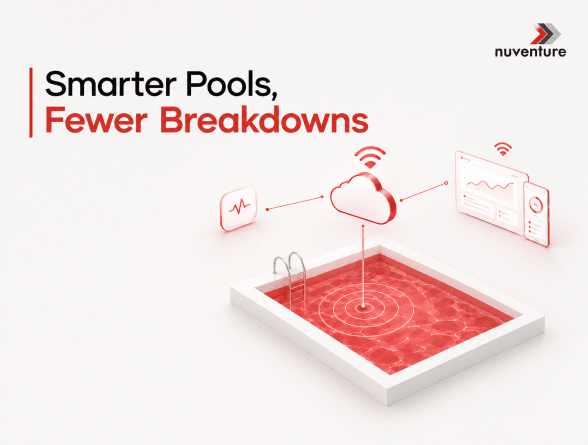
Nuventure’s own work bears this out at the equipment level. In a smart pool automation project built for a commercial pool equipment distributor, an IoT controller reading water parameters every fifteen seconds, connected over 4G and Ethernet and integrated with existing equipment through RS485 Modbus, cut maintenance time by 80 percent and reduced equipment breakdowns by 50 percent. Automated chemical dosing, driven by that same real-time data instead of manual test-strip readings, brought chemical costs down by 30 percent. None of these numbers came from replacing the underlying pool equipment, they came from finally being able to see, continuously, what it was doing.
The technical case is catching up with the practical one
The pool industry isn’t the one generating the underlying research here, industrial IoT is, and pool technology is simply one of the more concrete places to apply it. A 2025 study published in Scientific Reports proposed an ensemble model combining deep reinforcement learning with random forest and gradient boosting classifiers to predict equipment faults from streaming sensor data in industrial IoT networks, reporting an F1-score of 0.92 in fault detection, a measure that balances precision (how often a flagged fault is a real one) against recall (how many real faults actually get caught), meaningfully outperforming traditional rule-based and single-model approaches. The direction of that research matters as much as the specific number: the field is moving from static thresholds toward models that learn the specific operating behavior of a specific piece of equipment and adapt as conditions change, weather, usage load, water chemistry drift, all of which shift what “normal” looks like for a given installation over time. That’s a meaningfully harder engineering problem than a fixed alert system, and it’s also why the ROI is higher, a model that understands a pump’s actual baseline catches problems a static threshold would miss entirely, and catches them earlier in the P-F interval, when the fix is still cheap.
What this looks like for a connected pool product
For a business building or distributing pool equipment, the practical question isn’t whether predictive maintenance works, the reliability engineering and the field data both say it does, it’s how to get from hardware that runs blind to a platform that reports continuously, without a multi-year build. That’s the gap Nuventure’s end-to-end IoT services exist to close: the controller hardware, the connectivity layer, the mobile interface, and the predictive models trained on real operating data, delivered as one system instead of five separate vendor relationships. Swimming pool automation isn’t a single feature bolted onto existing equipment, it’s an architecture, sensors reporting continuously, a platform that learns what normal looks like for each installation, and an interface that turns a P-F interval into a scheduled service call instead of an emergency one. Pool automation done at this level doesn’t just prevent breakdowns, it turns every installed unit into a source of continuous data and, for the businesses that own the relationship with the end customer, a source of ongoing service revenue.
Where this goes next
The equipment already generates the signal, vibration, current draw, ORP drift, all of it, well before it generates a failure. The only question is whether anything is instrumented to read it. Nuventure has spent its history building the sensor-to-cloud layer that makes that signal usable, in water infrastructure, in industrial equipment, and specifically in pool technology, where the smart pool automation case study shows exactly what those numbers look like in practice. If your product line is ready to move from scheduled maintenance to predictive maintenance, talk to our engineering team about what an end-to-end IoT implementation would look like for your equipment.