If enterprises are investing more than ever in AI-powered workflow automation, why are so many still struggling to translate that investment into enterprise-wide business value?
The challenge isn’t a shortage of AI or automation technologies. It’s the growing complexity of enterprise systems and processes. According to the IBM Institute for Business Value’s Cut the Cost of Complexity: Get More from Your Technology with Intelligent IT Automation, many organizations are held back by disconnected data silos, legacy technologies, and opaque workflows that prevent intelligent automation from delivering enterprise-wide value. The report highlights that technology alone isn’t the barrier. Instead, fragmented workflows and legacy systems often prevent organizations from realizing the full potential of intelligent automation.
At Nuventure Connect, we’ve seen organizations struggle not because they lack automation tools, but because they modernize outdated workflows instead of redesigning them. Today, enterprise workflow automation connects people, processes, data, and AI to improve efficiency and deliver measurable business outcomes.
This article explores four common enterprise workflow automation mistakes, supported by industry research and practical strategies for building intelligent, scalable workflows.
Why Enterprise Workflow Automation Still Falls Short in 2026
Enterprise workflow automation has never been more accessible. From AI-powered workflow automation platforms and intelligent automation tools to low-code development and enterprise AI solutions, organizations have more technology choices than ever before. Despite growing digital transformation investments, many enterprises still struggle with disconnected operations, siloed business processes, and automation initiatives that fail to scale.
The issue isn’t the availability of technology, it’s actually how organizations are implementing it. According to the Capgemini Research Institute’s Harnessing the Value of AI: Unlocking Scalable Advantage, organizations that achieve the greatest value from AI don’t simply deploy new technologies, they redesign business processes, modernize operating models, and establish the organizational foundations required to scale AI successfully. The research reinforces a critical insight: AI-powered workflow automation delivers sustainable business value only when it is embedded into well-designed workflows rather than layered onto outdated ways of working.
Organizations are moving beyond task-based automation toward intelligent workflows connecting people, processes, data, and AI. Instead of focusing solely on efficiency gains, Leading enterprises use workflow automation to improve decision-making, operational agility, customer experience, and innovation.
For enterprise leaders, the question is no longer whether to automate workflows, but how to build a workflow automation strategy that supports long-term business transformation. The organizations that continue to treat automation as a standalone technology initiative risk creating fragmented digital ecosystems. Those that redesign workflows around business outcomes, AI readiness, and cross-functional collaboration are far better positioned to unlock enterprise-wide value.
Understanding this distinction is essential because the most significant barriers to enterprise workflow automation are rarely technical. They stem from the assumptions organizations make before implementation even begins.
The Four Workflow Automation Mistakes Holding Enterprises Back
Despite advances in AI-powered workflow automation, many enterprise initiatives fall short because of how automation is planned and implemented.
The following four mistakes appear consistently across industry research and real-world enterprise transformation initiatives. Together, they highlight the common barriers preventing organizations from realizing the full value of enterprise workflow automation and the approaches leading organizations use to overcome them.
Mistake #1 : Treating Enterprise Workflow Automation as a Technology Project Instead of a Business Transformation Strategy
Many enterprise workflow automation initiatives fail long before implementation begins. The problem isn’t choosing the wrong AI platform or automation tool. It’s treating workflow automation as an IT project instead of a business transformation initiative. When technology decisions take priority over business strategy, organizations automate individual tasks while leaving disconnected workflows and inefficient business processes unchanged.
This perspective is reinforced by McKinsey’s From Adoption to Impact: Three Horizons of AI Transformation, based on a global survey of 750 professionals. The research found that organizations creating meaningful enterprise value from AI treat transformation as an organizational change effort, not simply a technology deployment. Instead of expanding AI across isolated use cases, they redesign workflows, modernize operating models, invest in leadership and workforce readiness, and align AI initiatives with long-term business objectives.
The research points to four priorities for organizations building a successful workflow automation strategy:
- Align automation initiatives with strategic business goals.
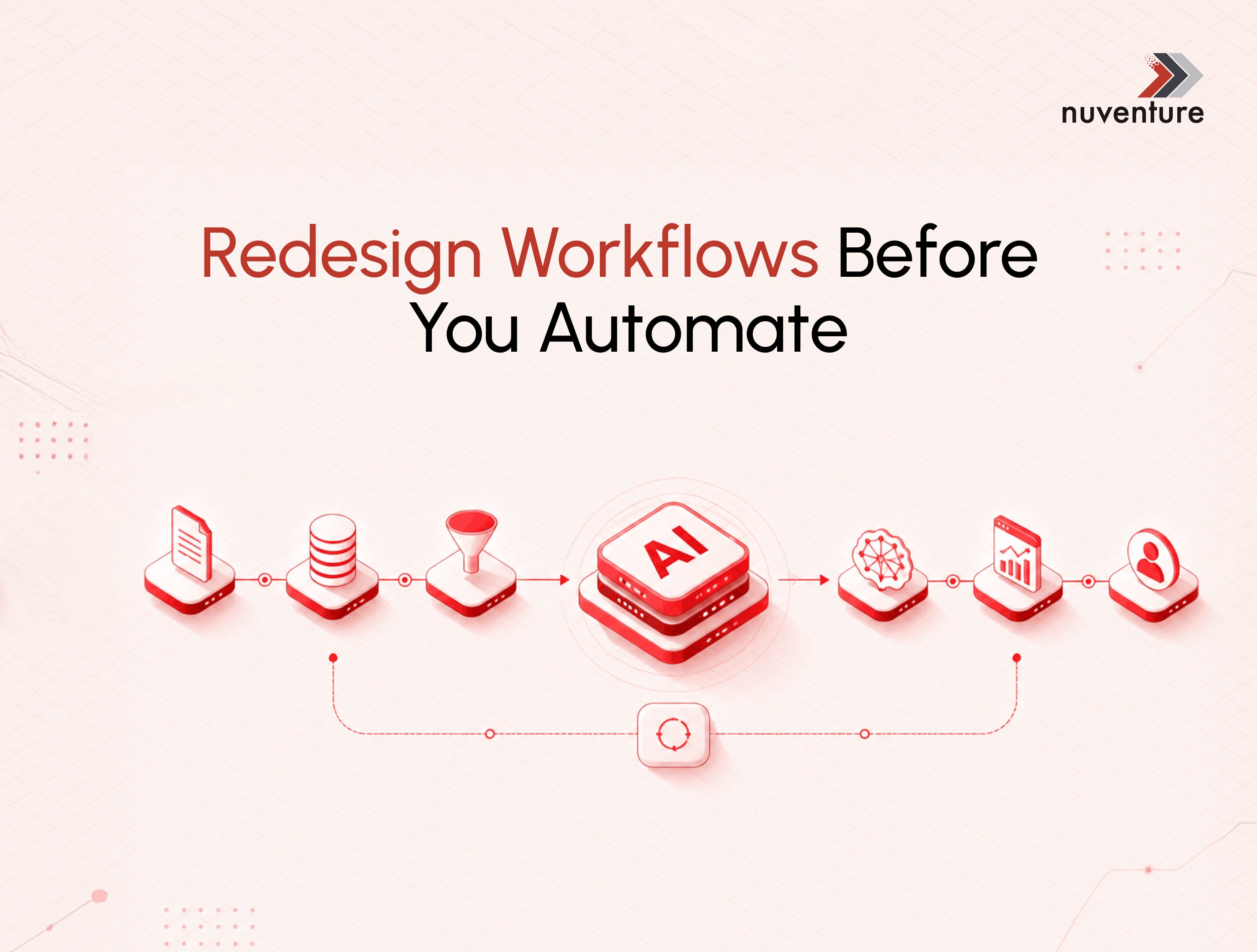
- Redesign workflows before introducing new technologies.
- Establish governance that supports enterprise-wide adoption.
- Prepare leaders and employees for new ways of working.
Ultimately, enterprise workflow automation should be treated as an ongoing business transformation journey rather than a one-time technology project.
Mistake #2 : Automating Broken Processes Instead of Optimizing Enterprise Workflows
A well-defined automation strategy is only as effective as the processes it supports. Many organizations invest in enterprise workflow automation without first ensuring workflows are efficient, standardized, or automation-ready.
As a result, technology is applied to processes that were never designed to operate at scale.
This challenge is highlighted in Harvard Data Science Review’s The Agent-Centric Enterprise: Why 2–10× Productivity Gains Demand Radical Workflow Redesign, the research explains that organizations achieve the greatest value from AI when they redesign workflows around how people and intelligent systems work together rather than embedding AI into existing processes.
In many enterprises, automation is introduced while underlying process challenges remain unresolved, including:
- Legacy approval workflows
- Disconnected applications
- Duplicate tasks and manual handoffs
- Complex , multi-step workflows that add little operational value
When these issues persist, even advanced AI-powered workflow automation delivers limited results.
Organizations that achieve stronger outcomes take a different approach. They focus on business process optimization by evaluating end-to-end workflows, removing unnecessary complexity, standardizing critical business processes, and then introducing automation where it creates the greatest operational impact.
Optimizing workflows before automating them enables enterprise workflow automation to improve operational efficiency, strengthen collaboration across teams, and support long-term business transformation.
Mistake #3 : Scaling AI Workflow Automation Without Building a Trusted Data Foundation
As Schneider Electric expanded its AI capabilities across the enterprise, the company recognized that scaling AI required more than advanced technology. In its AI at Scale podcast, Trusted Data Revolutionizes Business Success, chief Data Officer Una Shortt explains that trusted, well-governed data became the foundation for successful AI adoption. To support this effort, Schneider Electric established Business Data Officers to ensure AI solutions were built on trusted enterprise data.
This reflects a common challenge in AI–powered workflow automation. When enterprise data is fragmented, inconsistent, or poorly governed, AI produces unreliable insights and limits the effectiveness of automation.
Organizations looking to scale enterprise workflow automation should strengthen three core capabilities:
- Enterprise-wide data governance.
- Integration across business systems.
- Standardized, high-quality data management practices.
Trusted data is no longer just an IT responsibility. It is a strategic business capability that enables enterprise workflow automation to scale with confidence and deliver sustainable business outcomes.
Mistake #4: Measuring Workflow Automation Success by Efficiency Instead of Business Value
Operational efficiency has traditionally been the primary benchmark for evaluating enterprise workflow automation. Metrics such as tasks automated, time saved, and cost reduction indicate operational improvement, but they reveal little about whether automation is creating meaningful business outcomes or supporting long-term enterprise growth.
According to Deloitte’s State of AI in the Enterprise 2026, organizations are moving beyond productivity gains and using AI to redesign core business processes and operating models. The research shows that while many organizations report improvements in efficiency, only a smaller group are fundamentally reimagining how their business creates value through AI.
As AI adoption matures, leading enterprises are shifting toward outcome-based KPIs that evaluate how AI-powered workflow automation contributes to broader organizational goals, including:
- Customer experience and business value
- Decision-making speed and quality
- Operational resilience and business agility
- Long-term strategic growth
Organizations measuring workflow automation through business outcomes are better positioned to scale intelligent automation, adapt to changing market demands, and build resilient, future-ready enterprises.
From Workflow Automation to Enterprise Transformation
The four challenges explored in this article highlight a common reality: successful enterprise workflow automation depends less on the technologies organizations adopt and more on how they redesign the way work flows across the business. Organizations that align workflows, trusted data, AI, and business strategy are better positioned to scale automation and achieve long-term digital transformation.
This business-first philosophy shapes how Nuventure Connect partners with enterprises. Rather than approaching automation as a standalone technology initiative, Nuventure helps organizations modernize workflows, integrate AI into business operations, and build scalable engineering solutions with measurable business outcomes.
A practical example is How Nuventure Transformed a Global Enterprise: A DevOps Success Story. The enterprise faced slow software releases, manual deployment processes, and inconsistent delivery cycles. Instead of simply introducing new automation tools, Nuventure redesigned the software delivery workflow by implementing CI/CD automation, Infrastructure as Code (IaC), automated testing, and continuous monitoring. The transformation reduced deployment time from five days to just 17 minutes, while improving release reliability, delivery speed, and operational scalability.
Workflow automation delivers lasting business impact when technology is supported by well-designed processes, trusted data, and engineering excellence. Automation accelerates transformation, but sustainable results come from rethinking how work is performed before deciding how it should be automated.
Enterprise workflow automation has reached a point where success is no longer defined by the number of automated tasks or the sophistication of AI tools. It is defined by how effectively organizations redesign workflows, strengthen data foundations, align automation with business strategy, and measure success through meaningful business outcomes.
The four challenges explored in this article highlight a common lesson: technology alone cannot transform enterprise operations. Organizations that optimize workflows before introducing AI-powered workflow automation are better positioned to improve operational efficiency, scale intelligent automation, and achieve sustainable digital transformation.
Whether refining a workflow automation strategy or expanding AI across business operations, the first step is identifying where existing workflows create friction and where automation can deliver the greatest business impact.
Ready to rethink workflow automation for your enterprise?
Discover how Nuventure Connect helps enterprises redesign workflows, integrate AI into business operations, and build scalable digital transformation strategies that deliver measurable business outcomes.
When you’re ready to move beyond isolated automation initiatives, connect with our digital transformation experts to discuss a strategy tailored to your enterprise goals.